
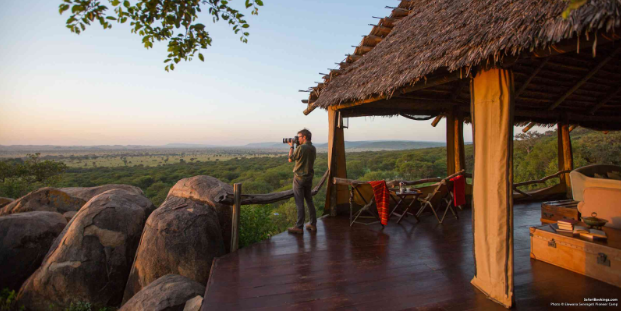
A Serengeti luxury safari lodge is not simply a place to sleep between game drives. It is a stage set at the edge of the ancient world — where the boundary between human comfort and wild Africa dissolves until you are no longer certain where the lodge ends and the Serengeti begins.
Introduction
There is a moment that every guest at a Serengeti luxury safari lodge eventually experiences. It happens at different times — sometimes at dawn, when the first light turns the plains from charcoal to gold and a lion calls in the distance; sometimes at dusk, when the sundowner gin is cold in your hand and the sky above the acacia trees is every shade of orange and violet simultaneously; sometimes in the deep silence of a mid-afternoon when you are lying in your canvas tent and you hear, very close, the sound of something large moving through the grass outside.
In that moment, the conventional categories of travel — accommodation, service, amenity, value for money — dissolve into irrelevance. What remains is the simple, overwhelming fact of where you are: in the middle of one of the most alive and ancient landscapes on Earth, housed in a structure that has been designed, with extraordinary care and craft, to place you as close as possible to that aliveness without sacrificing the human comforts that allow you to be fully present to it.
This is the achievement of the great Serengeti luxury safari lodge. Not the copper bathtub, though the bathtub is magnificent. Not the sommelier who appears at your canvas veranda at exactly the right moment, though that too is a considerable pleasure. The achievement is the seamless dissolution of the barrier between indoors and outdoors, between guest and landscape, between the human world you have temporarily left behind and the wild world that surrounds you completely.
This guide explores what defines a Serengeti luxury safari lodge experience, what to expect at different levels of the market, how lodge positioning within the park affects the quality of the wildlife encounter, and how to choose the right luxury lodge for the most extraordinary Serengeti experience your budget and travel dates allow.
What Defines a Luxury Safari Lodge in the Serengeti?
The term “luxury” is applied so liberally in the global hospitality industry that it has been largely drained of specific meaning. In the context of Serengeti safari accommodation, however, luxury retains a precise and substantive definition — one that goes significantly beyond thread counts and wine lists to encompass ecological positioning, guiding excellence, architectural philosophy, and the fundamental quality of the wildlife access the lodge delivers.
Spatial Generosity and Privacy
A defining characteristic of genuine Serengeti luxury is spatial generosity — the allocation of significant land and architectural space to each guest unit, ensuring that the lodge’s footprint in the landscape is both environmentally considered and experientially private. In the finest luxury tented camps and lodges, suites are positioned with sufficient separation that guests cannot see or hear neighbouring units, creating an experience of having the entire savannah to yourself.
This spatial philosophy extends to the common areas — the fire pit, the dining tent, the bar — which are designed for intimate use rather than mass hospitality. Maximum guest numbers at genuine luxury Serengeti camps are typically between twelve and thirty — a scale that allows the service team to know every guest by name and to anticipate preferences before they are expressed.
Architectural Integration with the Landscape
The finest Serengeti luxury lodges are designed with a deep commitment to architectural integration — the principle that a structure built in a landscape of extraordinary beauty should enhance rather than interrupt that beauty. The best camps use natural materials — canvas, timber, stone, thatch — that age gracefully into their surroundings. Infinity pools that appear to merge with the horizon. Viewing decks positioned to frame the plains through deliberate compositional choices. Dining areas open on three sides to the bush, with the fourth wall — the kitchen — discreetly behind.
This philosophy has ecological as well as aesthetic motivations. Luxury camps built with minimal permanent infrastructure can be deconstructed and the land restored if conservation priorities change or if better positioning becomes available. The low-impact footprint of the finest Serengeti camps is as much a statement of conservation values as it is a design choice.
Guiding Excellence
No component of the Serengeti luxury lodge experience is more important than the quality of resident guiding. The finest luxury properties employ senior naturalists with decades of Serengeti-specific experience — guides who know individual lion prides by their facial markings, who can find a well-habituated leopard in the Seronera acacias on a specific morning because they understand the animal’s territory and daily patterns intimately, and who can deliver natural history interpretation of sufficient depth and narrative quality to transform every game drive from observation into education.
Luxury camps typically maintain guide-to-vehicle ratios of one guide per vehicle and encourage — often require — that guests use the same guide for their entire stay, allowing a relationship and intellectual continuity to develop that enriches each successive game drive. Private vehicles, standard at the luxury level, ensure that the guide’s attention is entirely focused on your party’s specific interests and pace.
Comprehensive Inclusion
A hallmark of genuine luxury Serengeti camp pricing is comprehensive inclusion — the elimination of surprise costs through an all-inclusive model that covers accommodation, all meals, all beverages including premium wines and spirits, game drives, bush walks, laundry, and typically any specialist activity supplements available at the camp. This transparency of pricing is both a hospitality philosophy and a practical advantage, allowing guests to focus entirely on the experience rather than monitoring expenditure.
The Serengeti’s Luxury Lodge Zones
Central Serengeti — The Year-Round Benchmark
The Seronera area of the central Serengeti supports the highest concentration of luxury lodge and tented camp accommodation in the park, and for good reason: year-round wildlife density in this zone is exceptional, the road network is extensive and productive, and the area’s famous leopards in the riverside acacias — among the most reliably viewable in Tanzania — represent a consistently remarkable wildlife offering regardless of season.
Luxury camps in the central Serengeti are positioned to access both the kopje country of the wider Seronera area — home to lion prides, cheetahs, and the extraordinary variety of smaller predators and herbivores that define Serengeti biodiversity — and the seasonal migration herds that pass through the central zone during their northward and southward movements. For guests whose travel dates do not align with the peak calving season or northern crossings, the central Serengeti delivers a year-round luxury wildlife experience of outstanding quality.
The architecture of central Serengeti luxury camps tends toward the permanent: stone-and-canvas structures with full en-suite bathrooms, infinity pools overlooking the plains, and dining facilities that combine open-sided bush ambience with kitchen quality that would satisfy urban fine dining expectations. Several of Africa’s most celebrated safari properties are located in the central Serengeti, with histories of guest experience stretching across multiple decades and design philosophies that have influenced luxury safari architecture globally.
Northern Serengeti — The Exclusive Migration Frontier
The Northern Serengeti — the Lamai Wedge, the Mara River area, and the Kogakuria kopje country near the Kenyan border — is home to Tanzania’s most exclusive and most sought-after luxury tented camps. Located in the remotest corner of the Serengeti, accessible only by domestic light aircraft to the Kogatende airstrip, the northern camps offer a wildlife experience during the July to October Migration season that has no equal anywhere in East Africa.
Luxury camps in the Northern Serengeti are predominantly seasonal or semi-permanent — smaller, more intimate, and more architecturally ephemeral than their central Serengeti counterparts, designed to minimise their environmental footprint in one of the park’s most ecologically sensitive zones. Guest numbers are limited — the smallest northern camps accommodate as few as twelve guests — and the ratio of exclusive land to guest is extraordinary, creating an atmosphere of absolute wilderness privacy even during the peak crossing season.
Private vehicle access to Mara River crossing sites, managed through careful coordination between camp guides and the broader northern Serengeti guide network, delivers the flexibility and positioning quality that separates a luxury crossing experience from a standard one. Northern Serengeti luxury camps are booked twelve to eighteen months in advance for peak season and are among the most coveted accommodation experiences in the global luxury travel market.
Southern Serengeti and Ndutu — Calving Season Luxury
The Ndutu area and the broader southern short grass plains host a smaller but exceptional selection of luxury camps whose seasonal specialisation is the calving season of January to March. These properties are positioned on or adjacent to the calving grounds — the mineral-rich southern plains where the wildebeest concentrate for the birth of the year’s half-million calves — and are designed to maximise access to the predator-prey drama that defines this extraordinary ecological period.
Luxury in the southern Serengeti has a slightly different character from the central and northern camps: the landscape is more open and more vast, the light is extraordinarily photogenic, and the experience feels simultaneously more intimate and more overwhelming than the dramatic crossing season of the north. Several south-positioned luxury camps offer specialist photography guiding as a core service, with modified vehicles, professional wildlife photographers as resident guides, and post-drive image review sessions that elevate the southern Serengeti into one of Africa’s premier photographic safari destinations.
Western Corridor — The Undiscovered Luxury
The Western Corridor of the Serengeti — the tongue of protected land extending toward Lake Victoria — is the least-visited and most underappreciated zone of the park from a luxury accommodation perspective. A small number of exceptional camps in this area offer an experience of extraordinary exclusivity during the May to June Grumeti River crossing season, when the northward-moving Migration herds fill the corridor and the Grumeti’s enormous resident crocodiles create dramatic crossing encounters with minimal vehicle congestion.
Guests at Western Corridor luxury camps during the Grumeti crossing season experience the Migration with a solitude and intimacy that peak-season northern camps cannot offer, in a landscape of dramatic green season beauty that is among the most photogenic in the Serengeti ecosystem.
What to Expect: A Day at a Serengeti Luxury Safari Lodge
A typical day at a Serengeti luxury safari lodge camp is structured around the rhythms of wildlife activity rather than the rhythms of conventional hospitality. The alarm — if there is one — sounds before first light: 5:00 to 5:30 AM, when the kitchen team has already prepared hot coffee, tea, and a light snack to be consumed in the early morning darkness before departure.
The morning game drive begins at first light — the most productive period of the wildlife day — and typically runs for three to four hours, returning to camp between 9:00 and 10:00 AM for a full cooked breakfast served at the dining area or, in the finest camps, at a riverside location or a scenic overlook identified by your guide the evening before.
Mid-morning through early afternoon is camp time: the swimming pool, the shaded reading tent, specialist presentations by resident naturalists on topics from cheetah ecology to Maasai cultural history, and the long, restorative stillness of a canvas tent with the sounds of the African afternoon filtering through the mesh walls.
The afternoon game drive departs around 4:00 PM and runs until after sunset — finishing with a bush sundowner, set up by the camp team at a pre-selected scenic location with cold drinks, snacks, and the Serengeti sky at its most theatrical. Dinner, on return to camp, is typically four courses served by candlelight under open skies or in a dining tent whose walls have been opened entirely to the night.
Key Takeaways
- Genuine Serengeti luxury is defined by spatial generosity, architectural integration, guiding excellence, and comprehensive inclusion — not simply by high room rates, swimming pools, or the presence of luxury brand amenities.
- Lodge positioning within the Serengeti profoundly affects the quality of the wildlife experience — central Serengeti camps deliver year-round predator excellence; northern camps offer the Migration crossings; southern camps specialise in the calving season; western camps provide Grumeti crossing exclusivity.
- Northern Serengeti luxury camps are the most sought-after and most difficult to book — peak season availability requires twelve to eighteen months advance booking, and the finest properties accommodate as few as twelve guests in a landscape of absolute wilderness privacy.
- Guide quality is the single most important component of a luxury Serengeti camp experience — senior resident naturalists with decades of park-specific knowledge transform every game drive into a masterclass in Serengeti ecology and make the difference between a good safari and an extraordinary one.
- All-inclusive pricing is the standard at genuine luxury level — comprehensive inclusion of all meals, beverages, game drives, and activities eliminates surprise costs and allows guests to focus entirely on the experience.
- Architectural philosophy matters as much as amenity level — the finest luxury camps are designed to dissolve the boundary between indoor comfort and outdoor wilderness, creating an immersive experience that no amount of interior decoration in an isolated, enclosed structure can replicate.
- Seasonal specialisation is a strength, not a limitation — the best luxury Serengeti lodge experiences are those where the property’s design, positioning, and guiding expertise are specifically matched to the ecological season in which you visit.
Questions & Answers
Q: What is the average cost of staying at a Serengeti luxury safari lodge? A: Serengeti luxury safari lodge rates span a wide spectrum. At the entry level of the luxury tier, expect to pay approximately $800 to $1,200 per person per night on a fully inclusive basis at a high-quality permanent lodge with private vehicle game drives and comprehensive services. Mid-luxury tented camps in productive locations typically range from $1,200 to $2,000 per person per night all-inclusive. The most exclusive northern Serengeti camps and ultra-luxury properties with exclusive concession access range from $2,000 to $4,000+ per person per night at peak season. These rates include all accommodation, meals, beverages, game drives, and most activity supplements. Park fees — approximately $70 per person per day for non-residents — are sometimes additional and should be confirmed when requesting quotations. The green season (April to May) and shoulder season (November to December) offer rates 20 to 40% below peak season equivalents at most properties.
Q: What is the difference between a luxury lodge and a luxury tented camp in the Serengeti? A: The distinction is primarily architectural. A luxury lodge typically features permanent stone, timber, or concrete structures with enclosed walls, tiled bathrooms, and full hotel-grade infrastructure — closer in physical form to a conventional upscale hotel room, but positioned in a wildlife landscape and styled to reflect the surrounding environment. A luxury tented camp uses canvas structures on permanent or semi-permanent platforms, with mesh walls, canvas ceilings, and a design philosophy that prioritises acoustic and atmospheric connection to the bush over the weather-sealed enclosure of a lodge room. Tented camps are generally considered the more authentic and immersive luxury experience — the sounds, scents, and temperatures of the African night are present in a way that a lodge room cannot replicate. Both formats deliver exceptional comfort; the choice is primarily one of personal preference for immersion versus enclosure.
Q: Are children welcome at Serengeti luxury safari lodges? A: Policies vary significantly between properties. Many luxury Serengeti camps welcome children of all ages, particularly when families book exclusive-use of the entire camp — eliminating the concern that a child’s behaviour or schedule will affect other guests’ experience. Some of the most exclusive northern Serengeti camps impose a minimum age of eight to twelve years for standard bookings, reflecting the pace and intensity of the crossing season experience and the impact of young children on the atmosphere of very small, intimate properties. Families with children are strongly advised to discuss age policies and child programming directly with prospective camps before booking. The most family-forward luxury properties offer dedicated junior naturalist guides, specially designed children’s activity programmes, and flexible game drive scheduling that accommodates younger travellers’ energy and attention spans.
Q: What should I look for when comparing Serengeti luxury safari lodges? A: Beyond the obvious metrics of accommodation quality and included amenities, the most important comparison criteria for Serengeti luxury lodge selection are: zone positioning relative to the seasonal Migration phase during your travel dates; guide credentials — specifically the years of Serengeti experience and any specialist certifications held by the resident naturalist team; maximum guest numbers — smaller camps (under twenty guests) deliver a more exclusive and attentive experience; vehicle policy — confirm that private vehicle game drives are standard, not optional extras; conservation credentials — the most reputable luxury operators invest meaningfully in conservation and community programmes and can document this investment specifically; and the operator’s own intelligence network — the best properties maintain active field communication networks that inform daily game drive decisions with real-time wildlife positioning information.
Q: Can a Serengeti luxury lodge experience be combined with other Tanzania destinations? A: Absolutely — and the standard luxury Tanzania itinerary is precisely such a combination. The most common and rewarding luxury multi-destination itinerary combines two to three nights in the Ngorongoro Crater area (for Big Five completion and the extraordinary crater floor experience) with three to four nights in the Serengeti (at a camp positioned for the seasonal Migration phase) and three to four nights on Zanzibar (at a boutique Indian Ocean property for the marine and cultural finale). More extended luxury itineraries add Ruaha or Nyerere National Park via domestic flight for the southern Tanzania wilderness experience, and occasionally Mahale Mountains for chimpanzee trekking on the shore of Lake Tanganyika. Domestic flights between destinations are the standard transport format at the luxury level, with most Serengeti luxury camps located within a 45-minute flight of Kilimanjaro International Airport or neighbouring park airstrips.
Conclusion
The Serengeti luxury safari lodge experience is, at its finest, a paradox perfectly resolved: the most comfortable possible engagement with one of the world’s most uncomfortable and demanding environments. Not uncomfortable in the sense of physical hardship — the beds are exceptional, the food is remarkable, and the service is among the most attentive and perceptive in the global hospitality industry. Uncomfortable in the deeper sense of a landscape that makes no accommodations for human preferences, that operates on entirely its own scale of time and priority, and that reminds you, gently but persistently, that you are a visitor here, not a resident.
The great luxury camps of the Serengeti have understood this paradox and built their entire philosophy around it. They do not attempt to insulate you from the wilderness. They attempt to place you within it, comfortably enough that you can be fully present to everything it offers, and close enough that the membrane between your experience and the ecosystem’s life is as thin as canvas.
Lying in a luxury tent at three in the morning with hyenas calling close to the perimeter, you are simultaneously in one of the most comfortable beds in Africa and as close to the raw, unmediated wild as you have ever been. That combination — of deep physical comfort and deep ecological proximity — is what the Serengeti luxury lodge offers that no other travel experience can replicate.