
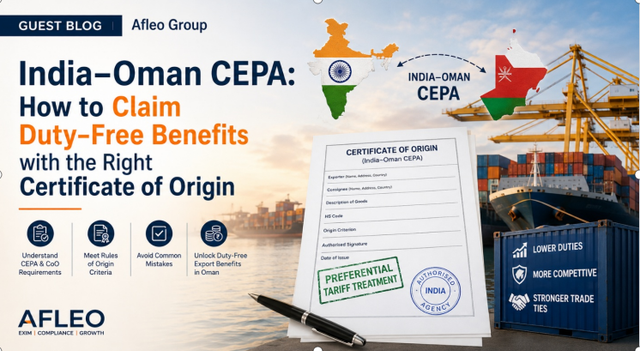
| The India–Oman CEPA went live on 1 June 2026, granting duty-free access to 99.38% of India’s exports by value. But accessing those benefits isn’t automatic — your shipment must be accompanied by the correct Certificate of Origin (CoO). |
If you’re an Indian exporter selling to Oman, the tariff advantage you’ve been waiting for is finally here. However, many exporters are discovering that the devil is in the documentation. A missing or incorrectly issued Certificate of Origin can result in your goods being assessed at the standard Most Favoured Nation (MFN) rate — wiping out the entire price benefit the CEPA was designed to deliver.
In this guide, we walk you through exactly what you need, who issues it, and how to get it right the first time.
What is a Certificate of Origin and Why Does it Matter Under CEPA?
A Certificate of Origin is a trade document that certifies the country in which a product was manufactured or substantially transformed. Under a Free Trade Agreement or CEPA, customs authorities at the destination country use the CoO to verify that imported goods are eligible for preferential tariff treatment.
Under the India–Oman CEPA, Oman’s customs will accept preferential tariff rates only for goods that:
- Were manufactured or substantially transformed in India
- Meet the Rules of Origin (RoO) requirements specified in the agreement
- Are accompanied by a valid Certificate of Origin issued by an authorised agency in India
Skip any one of these three, and your goods pay the standard duty rate.
Who Issues the CoO for India–Oman CEPA?
The authorised agencies for issuing preferential CoOs under India’s CEPAs and FTAs are:
- Export Inspection Council (EIC) — for notified goods including engineering products and chemicals
- Export Promotion Councils (EPCs) — sector-specific councils such as EEPC India (engineering), APEDA (agriculture and processed food), MPEDA (marine products)
- Federation of Indian Export Organisations (FIEO)— a widely accessible option for non-sector-specific goods
- Commodity Boards— for items such as spices, rubber, coffee, and tea
You cannot self-certify for the India–Oman CEPA. The CoO must bear the authorised agency’s seal, signature, and reference number.
Rules of Origin: The Eligibility Test
The Rules of Origin under the CEPA define what qualifies as ‘Indian’ for tariff purposes. There are two primary tests:
- Wholly Obtained Criterion:Goods that are entirely produced in India — such as agricultural produce, minerals mined in India, or marine products caught in Indian waters — automatically qualify.
- Substantial Transformation Criterion:Goods manufactured using imported inputs must meet one of the following thresholds:
- Change in Tariff Classification (CTC): the HS code of the finished product must differ from the HS code of the imported inputs at a specified digit level
- Value Addition Rule: a minimum of 35% value must be added in India (the local value content threshold under most chapters)
Before applying for a CoO, verify which Rule of Origin applies to your HS code. Your DGFT consultant or Export Promotion Council can assist with this assessment.
Step-by-Step: How to Apply for a CEPA CoO
- Register on the DGFT Trade Connect portal at dgft.gov.in and link your IEC
- Identify your product’s HS code and confirm it is eligible for CEPA preferences
- Verify your product meets the applicable Rule of Origin (wholly obtained or substantial transformation)
- Prepare your commercial invoice, packing list, and shipping bill
- Apply to your authorised issuing agency (EIC, relevant EPC, or FIEO) with all required documents
- The agency verifies your application and issues Form AI (the standard CEPA CoO form)
- Attach the original CoO to your export shipment; a copy must be submitted to Oman customs at the port of entry
Processing time varies by agency. EIC typically processes within 2–3 working days. FIEO and EPCs can be faster for simple cases.
Common Mistakes That Invalidate Your CoO Claim
| Our team regularly sees customs holds in Oman caused by CoO errors that could have been avoided with better preparation. |
- HS code mismatch between the CoO and the commercial invoice
- Description of goods that does not match the actual shipment
- Using a non-authorised agency or an outdated form (some agencies still issue pre-CEPA templates)
- Missing ‘back-to-back’ CoO for re-exported goods that transited through a third country
- Claiming substantial transformation without meeting the 35% local value content threshold
- Submitting a photocopy instead of the original CoO to Oman customs
The Transshipment Rule: A Critical Watch Point
If your goods transit through a third country (for example, via the UAE or Singapore) on their way to Oman, you must be especially careful. The CEPA allows transshipment provided:
- The goods remain under customs control in the transit country
- No further processing or manipulation occurs in the transit country beyond unloading, reloading, and storage
- Documentary evidence of transit (such as through bills of lading and transit customs documents) is available
If you are using Oman’s logistics hubs at Sohar, Duqm, or Salalah as a re-export base for the wider GCC region, separate CoO requirements apply for each onward destination. Consult with your customs broker before structuring the shipment.
Why Getting the CoO Right Matters More Than Ever
Under the CEPA, Oman’s customs is expected to conduct enhanced verification of preferential claims — particularly in the first 12–18 months of implementation, when fraudulent origin claims are most likely to appear. The agreement includes post-clearance audit provisions, meaning even a successfully cleared shipment can be reviewed later. Incorrect CoOs discovered post-clearance result in:
- Recovery of the full customs duty that should have been paid
- Penalty charges on the unpaid duty amount
- Potential suspension from preferential treatment for future shipments
Getting it right from the start protects not just this shipment but your long-term standing with Oman customs.
| Need help with Certificate of Origin documentation for the India–Oman CEPA? Afleo Group handles end-to-end CoO applications and DGFT compliance for Indian exporters. Contact us at afleo |
About Afleo Group: Afleo is a Mumbai-based DGFT and Customs Consultancy firm providing comprehensive EXIM solutions including Certificate of Origin, IEC registration, EPCG, Advance Authorisation, and freight forwarding services. With deep expertise in India’s Foreign Trade Policy, Afleo helps Indian businesses navigate customs compliance and maximise their export benefits.