
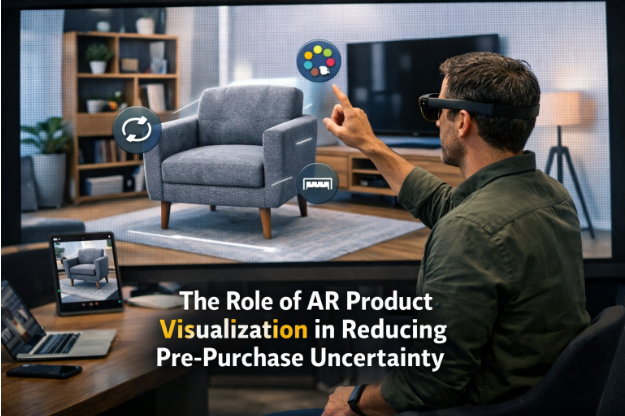
Although it is a reality that the rise in online purchases has greatly increased access to goods and products, it has also introduced a new issue in this regard, which was that consumers were not able to perceive and engage with products even before purchasing them. This, in a normal course, translates into a state of hesitation, confusion, and doubts among consumers.
This condition has been pooled under a single term known as “pre-purchase uncertainty.” This, in turn, explains why a growing number of companies are opting for AR product visualization technology in relation to AR, in that it ensures that consumers are able to view, modify, and place electronic products in their space.
However, when it comes to the reality and accuracy of AR experiences, this has a lot to do with the expertise of a professional 3D modeling company, which has been able to develop extremely detailed 3D models that are ideal for use in augmented reality. These models also help a customer to examine a product as though it were in front of their eyes.
This is a close evaluation of how AR product visualization using augmented reality technology affects purchasing hesitation and modifies buying behavior.
1. Virtual Placement in a Real-World Context
Uncertainty related to how a product will look in the buyer’s environment is also a major source of uncertainty. This is where AR product visualization can help consumers place a replica of a product in their own home, office, and other spaces.
This assists the customer in understanding:
- True size and scale of the object
- Whether it fits in the intended location
- How it adds to other colors in décor
- Applying it in practical situations
Removing the element of guessing, actual placement on the ground becomes a major confidence-booster.
2. 360-Degree Interactive Product Exploration
While a picture of a product in a catalogue does not show all angles of it, augmented reality technology, on the other hand, provides consumers with a view of all product angles.
The 3D modeling company provides high-quality models that are able to display to the users:
- Textures and material finishes
- Handwork and detailing
- Functional components
- Overall design structure
This represents a level of access that simulates that of an in-store experience, thereby reducing uncertainties.
3. Presenting Product Features in More Visibility
To purchase, it’s essential to know how a product works, and with augmented reality, it’s possible to show how it moves, what it looks like internally, and how it can be used in a way that a picture can’t.
AR can communicate:
- Convertible mechanism
- Assembly Procedure
- Demonstrations of features
- Operational Behaviour
To this end, when consumers are aware of how a product operates, this instills in them a certain amount of confidence in relation to purchasing it.
4. Enhanced Expectation Accuracy to Minimize Returns
One of the reasons consumers return a product can be found in the area of anticipation vs. experience. Product visualization from AR bridges this gap, as consumers are able to experience a substantial, realistic preview of a product.
This reduces all uncertainties in relation to:
- Color accuracy
- Product size
- Matérial look and feel
Where promise meets delivery, satisfaction with products increases, and returns are fewer.
5. Increasing Transparency to Help Improve Customer Confidence
A customer would always value a brand that can display what they would take home, with no vague information. Transparency in this manner is provided by allowing a customer to check a product before buying.
This transparency results in:
- High Brand Credibility
- Enhanced customer relations
- Greater perceived value
- Improved purchasing decisions
With the help of how 3D modeling companies are precise, AR visuals can now be an objective representation of a product.
6. Accommodating Customization that Builds Buyer Confidence
There are a few customers who are reluctant to buy due to their doubts about whether this product line, this finish, this configuration, if offered, would be the right choice. This problem can be solved by augmented reality.
Users are offered the following options:
- Color variations
- Material finishes
- Size corrections
- Font styles
While the customers are watching, alterations can be done in a split second. They realize that they are making the right choice among all the options, as per their requirements.
7. Building an Emotional Bond that Overcomes Procrastination
AR brings inspiration as it not only informs but also engages. The consumers are greatly emotionally invested in the product, which they are able to see in their own surroundings. There needs to be an element of emotional comfort that overcomes hesitation.
Emotion has a massive role in overcoming uncertainties, and it becomes natural and effective with the help of AR.
8. Provide a More Interesting and Memorable Experience of Shopping
A pleasant shopping experience instills confidence. This is because AR enhances passive browsing to become an active discovery, thereby enabling consumers to feel a sense of control when making decisions.
Immersive AR Experience:
- Achieve intuitive product understanding.
- Less use of sales support
- Make it easy for potential buyers to imagine different scenarios
- Make shopping a pleasant experience
To increase knowledge, it has to be absorbed. If a person is uncertain, it means that knowledge is yet to be understood.
Conclusion
“Pre-purchase uncertainty” has long been considered among the most painful issues faced by online consumers, and this completely shifts as a result of AR product visualization. Offering context, interactive discovery, precise information, and a deepened emotional connection are all ways in which AR brings consumers both information and a level of confidence to make informed purchasing decisions.
The reality and authenticity of these experiences rely on the quality of models that are developed by a professional 3D modeling company in order to ensure that what a customer sees is, in fact, what he or she will receive. With advancements in AR technology, it has been foreseen that its use in the removal of doubt as well as in improving the overall purchasing experience will increase, hence making it a necessary part of every brand’s arsenal in establishing trust.